

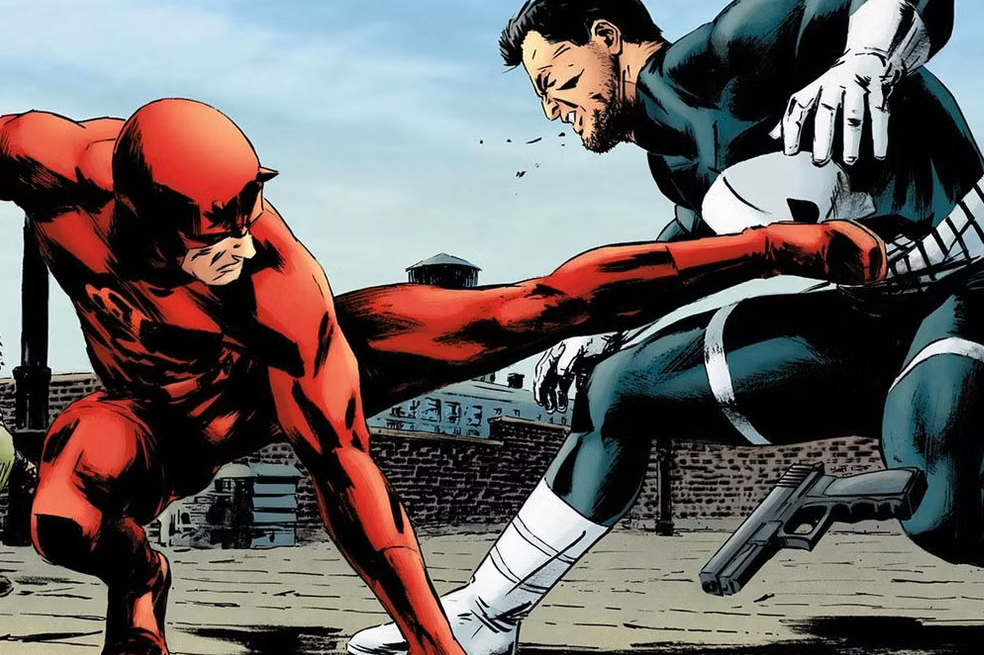
Some superheroes save the city. Some superheroes turn the city into a crime scene with branding.
That is the problem with Punisher vs. Daredevil, and also the reason fans keep dragging these two into the same moral cage match. Frank Castle and Matt Murdock both hunt criminals in Marvel’s New York. Both move through alleys, rooftops, warehouses, and courtrooms filled with people who absolutely should have chosen accounting instead of organized crime.
Then the similarities start bleeding out.
Daredevil believes justice still needs limits, even when the law is slow, corrupt, or dressed in a white suit named Wilson Fisk. Punisher believes the system already failed. His solution involves planning, ammunition, and a skull logo with the emotional warmth of a tax audit.
That is why Frank Castle vs. Matt Murdock works as more than a superhero fight. It is a character comparison between two broken men who looked at evil and built different lives around it. Matt built a moral code. Frank built a war.
Annoyingly, both men have a point.
Punisher vs. Daredevil in One Ugly Sentence
Daredevil fights criminals because he believes people can still face judgment without being executed. Punisher kills criminals because he believes some people crossed a line that should not come with a second chance.
That sounds simple. It is not. Comics love pretending the answer is easy, then throwing a dead family, a corrupt court, a Catholic guilt spiral, and a ninja death cult into the room. Very subtle medium. Extremely restrained.
Matt Murdock is a lawyer, Catholic, martial artist, and professional bad decision machine. He believes in the law during the day, then spends his nights breaking into criminal hideouts in a devil suit. This is not hypocrisy hidden under layers of symbolism. It is hypocrisy wearing red leather.
Frank Castle is a former Marine whose family was murdered. He turned grief into a mission with no appeal process. No courtroom. No mercy hearing. No dramatic speech about rehabilitation. Frank sees violent criminals as threats to remove.
The real difference is not violence. Matt has folded plenty of men into hospital furniture. The difference is what happens after the fight.
Daredevil leaves a criminal breathing.
Punisher leaves evidence.
Frank Castle vs. Matt Murdock at a Glance
| Category | Daredevil | Punisher |
| Real name | Matt Murdock | Frank Castle |
| Main identity | Lawyer and vigilante | Soldier and executioner |
| Core trauma | Blindness, dead father, guilt | Murdered family, war, rage |
| Method | Martial arts, fear, investigation | Firearms, tactics, final force |
| Moral center | Justice with restraint | Punishment with certainty |
| View of the law | Flawed but necessary | Failed beyond repair |
| View of criminals | People who must be stopped | Threats that must be erased |
| Symbol | Devil | Skull |
| Best genre | Noir crime drama | Revenge war story |
| Biggest flaw | Hypocrisy with abs | Certainty with a body count |
This table is harsh because the characters are harsh. Nobody opens a Daredevil or Punisher story looking for emotional wellness, good communication, and ergonomic lighting.
The key point is simple. Frank makes Matt look naïve. Matt makes Frank look monstrous. The irritating genius of Marvel is that both accusations land.
Daredevil Believes Justice Needs a Soul
Daredevil’s entire character depends on contradiction. Matt Murdock spends the day defending the legal system. At night, he corrects its failures with fists, acrobatics, and a costume that screams, “I have processed none of my trauma.”
Matt believes the law matters because the alternative is worse. Without process, guilt becomes whatever the angriest person in the room can prove through force. That is exactly where he separates himself from Frank Castle.
Matt Murdock’s No-Kill Rule Is the Whole Point
Daredevil’s no-kill rule is not decorative hero branding. It is the wall keeping Matt from becoming the thing he fears.
Matt knows he enjoys the fight more than he should. He knows anger drives him. He knows pain can start sounding like justice if you let it talk long enough.
His rule gives him a boundary:
- Stop the criminal.
- Protect the innocent.
- Deliver the guilty to judgment.
- Refuse the role of executioner.
That last one matters most. Matt already operates outside the law. Without restraint, he becomes a judge in a mask with no jury and no appeal.
Daredevil Protects the Possibility of Redemption
Daredevil stories often leave room for change. Not always. Some villains are committed to being garbage with excellent tailoring. Still, Matt usually believes people are more than their worst act.
That belief is not soft. It is harder than Frank’s worldview in many ways. Killing a criminal closes the file. Letting someone live means accepting risk. It means mercy may fail later. It means the person you spared might hurt someone else.
Matt carries that burden because justice without mercy becomes revenge with nicer vocabulary.
This is why Daredevil works so well against Marvel villains like Kingpin, Bullseye, and the Hand. The question is not only whether Matt can win. The question is whether he can win without surrendering the part of himself that still believes.
His Hypocrisy Makes Him Human
Daredevil is a hypocrite. There, we said it. Matt can now brood on a rooftop for six issues.
He condemns Punisher for taking the law into his own hands while doing illegal rooftop gymnastics every night. He argues for due process while collecting evidence in ways that would make a judge develop a migraine. He wants to protect people, yet his secret life keeps wrecking the lives of everyone close to him.
That hypocrisy does not ruin the character. It powers him.
Matt is compelling because he knows the contradiction. He suffers inside it. Frank has certainty. Matt has doubt. Doubt is more human, especially when it comes with radar senses and the sleep schedule of a haunted raccoon.
Punisher Believes Evil Forfeits Protection
Frank Castle is the nightmare answer to one question. What happens when someone stops believing justice can arrive through the law?
His answer is not elegant. It is not balanced. It is not waiting for a panel discussion. Frank sees predators, killers, traffickers, mobsters, and corrupt power brokers. Then he removes them.
That is the Punisher fantasy. It is also the Punisher problem.
Frank Castle Wages War, Not Patrol
Punisher stories are war stories wearing a superhero universe as a jacket. Frank does not patrol like Spider-Man. He campaigns.
His process usually looks like this:
- Identify the criminal network.
- Study the operation.
- Find the weak points.
- Strike hard.
- Leave nobody dangerous enough to regroup.
That makes him terrifyingly effective. He does not need a confession in court. He does not need the system to catch up. He has already decided that certain people are beyond mercy.
This is where Punisher becomes seductive as fiction. He gives readers the ugly satisfaction of final consequences. A villain hurts people. Frank makes sure they never do it again. Clean. Brutal. Morally radioactive.
Punisher Has a Code, Which Is Not the Same as Mercy
Frank is not random. He is not a slasher villain with better tactical gear. He targets criminals, especially people who prey on the innocent. In many stories, he avoids civilians and shows grim respect for people trapped by the same rotten systems he hates.
His code is clear:
- Innocents are protected.
- Predators are punished.
- Criminal empires are targets.
- Excuses do not matter.
That code gives him shape. It does not make him safe.
A moral code can be consistent and still horrifying. Frank’s rules leave no room for error once he decides someone belongs on the wrong side of them. That is the danger. His certainty feels powerful because it skips every slow, frustrating part of justice.
It also skips the safeguards. Funny how that works.
Frank’s Certainty Is His Curse
Daredevil doubts. Punisher decides.
That certainty makes Frank effective. It also traps him. He cannot heal because the mission gives his grief structure. Stopping would mean facing the emptiness under the war. Naturally, he chooses another weapons cache instead. Very emotionally mature. Truly the model of inner peace.
Frank’s tragedy is that he wins constantly and never becomes free. Every dead criminal proves the mission continues. Every mission proves the world is still rotten. Punisher does not move toward peace. He moves toward the next target.
The best Punisher stories understand this. They let the revenge fantasy work, then show the cost. Frank Castle is justice stripped of hope. That is not heroism. That is consequence with a skull on it.
Why Punisher and Daredevil Clash So Well
Some superhero rivalries are just personality problems with more punching. The differences between Punisher and Daredevil matter because the two characters argue over the purpose of vigilantism.
Both operate outside legal authority. Both believe the system fails. Both use fear as a weapon. The fight begins when they decide what failure permits.
They Expose Each Other’s Weakest Argument
Frank forces Matt to answer a brutal question. If a murderer will kill again, and the courts keep failing, is sparing him still moral?
Matt forces Frank to answer an even uglier one. If you decide guilt and punishment alone, what separates you from every tyrant who claimed violence was necessary?
Neither question has a clean answer. That is why the rivalry works.
Daredevil makes Punisher look like a man who confused grief for justice. Punisher makes Daredevil look like a man protecting principles while bodies pile up. This is not a tidy hero versus antihero setup. It is Marvel placing two damaged philosophies in a room and letting them bite each other.
Their Symbols Tell the Whole Story
Daredevil wears a devil symbol, which is almost funny given how much time he spends trying to stay morally clean. Matt dresses like damnation while fighting to preserve grace. Subtle? No. Effective? Absolutely.
Punisher wears a skull. No ambiguity. No redemption metaphor. No spiritual wrestling. The symbol says death is coming, and Frank is bringing the schedule.
Their symbols reveal their inner worlds:
- Daredevil is temptation resisted.
- Punisher is judgment delivered.
- Daredevil fears becoming damned.
- Punisher already lives there.
That is comic book symbolism at its loudest, which means it is operating correctly.
Moral Philosophy Without Pretending This Is a College Lecture
Like Marvel’s Civil War, the Daredevil vs. Punisher debate usually lands on one issue. Is justice about process, or is justice about outcome?
Daredevil says process matters. If the right person does the wrong thing for the right reason, society still loses something. The law must have limits because power without restraint becomes abuse.
Punisher says outcomes matter more. If a murderer keeps escaping punishment, then process has become a shield for evil. Frank does not care if the system feels noble while innocent people die.
Both views come with problems.
Daredevil’s View Can Feel Painfully Slow
Matt’s belief in due process sounds noble until the villain escapes again. Then it sounds like a luxury paid for by future victims.
That is the strongest argument against Daredevil. His mercy can look irresponsible when criminals keep returning. Every repeat offender becomes a mark against his code.
Still, Matt’s point remains strong. A world where one angry man decides who lives is not justice. It is rule by impulse, even when the impulse has tragic backstory lighting.
Punisher’s View Can Feel Dangerously Satisfying
Frank’s view feels satisfying because it gives immediate results. No corrupt judge. No bribed witness. No prison escape. Problem solved.
Except humans are terrible at absolute certainty. Evidence can be wrong. Anger can distort judgment. Trauma can disguise itself as clarity. Once killing becomes a tool of justice, the person holding the weapon becomes the system.
That is the nightmare Matt sees in Frank. Punisher may kill monsters, but his method creates a world where the most damaged person in the room gets the final say.
Fantastic. Very stable. Nothing could go wrong there.
Who Would Win in a Fight?
As with any ranking of the strongest Marvel characters, the most honest answer is that the writer wins. Yes, that is annoying. It is also true, and comic fans must occasionally drink water and accept reality.
In a straight physical fight, Daredevil has the advantage in mobility, senses, close combat, and improvisation. Matt can hear heartbeats, read movement, fight in darkness, and turn a narrow hallway into a bad medical forecast.
In a prepared tactical encounter, Punisher becomes far more dangerous. Frank studies patterns. He sets traps. He brings weapons suited to the target. He fights like someone who did the homework, then brought explosives to the exam.
So the fight depends on conditions:
- Close quarters with little prep: Daredevil likely wins.
- Open ground with Punisher prepared: Frank becomes a nightmare.
- Moral confrontation: Daredevil usually wins the argument.
- Practical crime removal: Punisher gets faster results.
- Long-term impact: Daredevil leaves a city with more hope.
The interesting answer is not who wins. The interesting answer is what each man has to become in order to win.
Final Verdict on Punisher vs. Daredevil
Daredevil is the better hero. Punisher is the sharper warning.
Matt Murdock believes justice needs limits, mercy, and accountability. He fails often because he is a disaster in red. Still, his code keeps him fighting for something larger than his own pain.
Frank Castle is effective, terrifying, and often right about how broken the system is. That does not make his answer good. It makes his answer tempting. That is the entire danger of the Punisher.
So in Punisher vs. Daredevil, the real winner is the story itself. Frank Castle and Matt Murdock make each other better characters because they drag the ugliest parts of vigilantism into the light.
Daredevil asks what justice costs when you refuse to kill.
Punisher asks what justice becomes when killing is the answer.
And Marvel, being deeply rude, refuses to let either man walk away clean.